
In 1907, Pablo Picasso painted a woman with two eyes on the same side of her face, a nose that existed in profile and front-on simultaneously, and a body that seemed to occupy five places at once.
The art world was confused. Then fascinated. Then changed.
Les Demoiselles d’Avignon didn’t make sense as a portrait. But it made profound sense as a truth — showing a subject not as we see them from one angle at one moment, but as we actually know them: from many sides, all at once.
That’s Cubism. And it has more to say about your brand than you might think.

What Cubism Was Really Doing
Cubism — developed by Picasso and Georges Braque in early 20th-century Paris — broke a rule that had governed Western painting since the Renaissance: the rule of single-point perspective. One viewpoint. One moment. One “truth.”
Cubists looked at that rule and asked: but why?
Reality isn’t experienced from one angle. We walk around things. We see them over time. We know them from memory and anticipation, not just from this one frozen moment.
So they painted that. Objects fragmented into planes and angles. Subjects shown from multiple perspectives simultaneously. Reality cracked open to reveal its complexity.
It was, depending on who you asked, either a disaster or the most important thing that had happened in art in five hundred years.
(It was the second one.)
What Cubism Can Teach You About Your Brand Positioning
You Are Not One-Dimensional
The biggest mistake wellness coaches make in their branding is collapsing themselves into a single note.
I help women heal their relationship with food. Full stop. That’s the brand. That’s all people know.
But you are not one-dimensional. Your clients are not one-dimensional. The transformation you create doesn’t happen from a single angle.
Cubism teaches us that the most interesting version of something is the one that shows its complexity — that lets us see it from multiple sides without falling apart.
Your brand can hold: expertise and warmth. Authority and approachability. A clear niche and depth of perspective. You don’t have to choose.
Different Clients See Different Facets
Picasso’s Cubist portraits showed the same subject from multiple viewpoints simultaneously because that’s how we actually experience people — not as a fixed image, but as a collection of impressions that build into knowing.
Your potential clients come to you from different angles too.
Some find your Pinterest. Some find your blog. Some are referred. Some see your Instagram. Each of these touchpoints is a different face of the same subject — and they should all feel like you, even if they’re showing different facets.
This is why brand consistency matters so deeply. Not because everything should look identical — but because every touchpoint should feel like it belongs to the same whole.
Break Conventional Perspective
Braque made a radical discovery when he visited Cézanne’s studio: you didn’t have to represent space the way everyone said you had to represent space. The rules were a choice. And choices could be unmade.
In branding, conventional perspective looks like this:
- Everyone in wellness uses soft, muted, nature-adjacent colours
- Everyone uses a calming, slightly formal tone
- Everyone has a hero section that says some version of “I help you feel better”
You are allowed to break these conventions. You are allowed to have a brand that looks different, sounds different, and positions differently — not for the sake of being disruptive, but because you are actually different.
The coaches who stand out aren’t the ones who execute the wellness brand template most perfectly. They’re the ones who had the nerve to ask: what if we looked at this from a different angle?
Analytical Thinking + Emotional Resonance
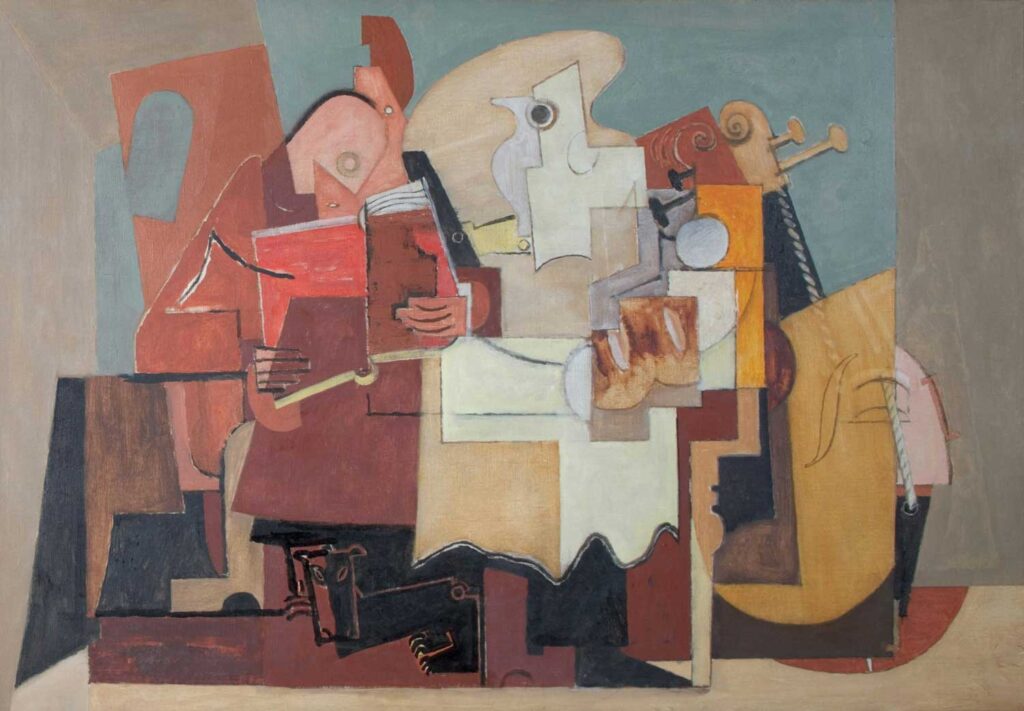
Cubism had two major phases: Analytic (breaking down subjects into structural elements, mostly monochromatic) and Synthetic (rebuilding them with collage, colour, and texture).
First you understand the structure. Then you bring it to life.
This is exactly the process of great brand building.
Analytical phase: What is my actual positioning? Who specifically do I serve? What is the problem I solve and why am I the right person to solve it?
Synthetic phase: How do I visually and verbally communicate that in a way that resonates, attracts, and converts?
Most brand-building mistakes happen when people skip the analytical phase and jump straight to choosing fonts and colours. The result is beautiful design with nothing underneath it.
Do the structural work first. Then make it beautiful.
The Cubist Brand Audit
Brand positioning tips from Cubism for your business…
| Cubist Principle | Brand Question |
|---|---|
| Multiple perspectives | Does your brand show different facets of who you are, or is it stuck on a single note? |
| Consistent through angles | Do your different platforms and touchpoints feel like they belong to the same brand? |
| Break conventional perspective | Are you executing the industry template, or are you doing something distinctly yours? |
| Structure before surface | Do you know your positioning deeply before you start making visual decisions? |
The Partnership That Changed Everything
Picasso and Braque developed Cubism together — exchanging ideas, challenging each other, sometimes working so closely their paintings were indistinguishable. Then World War I separated them, and both continued independently.
But neither went back to painting the way they had before. Once you’ve seen from multiple angles, single-point perspective feels like a limitation.
Once you’ve built a brand that genuinely reflects who you are — with depth, consistency, and the confidence to look different — you won’t want to go back to the template either.
The Bottom Line
Cubism was controversial, confusing, and revolutionary — and it changed art permanently because it told a more complete truth.
Your brand has that same potential.
Not by being confusing. But by being multi-dimensional: grounded in clear positioning, expressed consistently across every touchpoint, and brave enough to show more than one face.
The coaches people remember aren’t the ones who looked most like everyone else. They’re the ones who found an angle nobody else was showing — and committed to it.
That’s what Cubism did. That’s what the best brands do.
Pick your perspective. Make it yours. Then show it from every angle.